
Time management is one of the most common day-to-day pressure points with ADHD. It makes sense. If the condition involves focus challenges, a busy mind, and divergent thoughts, then time, schedules, and sequencing are going to be harder work than they look from the outside.
There is also a trap here. You can “manage” time without ever feeling settled. You can get through, deliver, and still feel permanently on edge.
Hypervigilance
Many ADHD people develop coping strategies that look like competence but feel like strain.
In my case, I’ve always prided myself on being punctual. The way I achieved that was not calm organisation. It was hypervigilance. I was constantly anxious about dropping balls, messing up, and letting people down, so I went miles out of my way to be on time. When problems leaked through, it was usually when I relaxed.
The signs were always there. I would get a panicky feeling looking at my diary. I would feel overwhelmed if someone asked me to plan “on the hoof” outside of work. Even when I did look at a calendar, I would still worry I had things wrong. Masking often looked like checking, rechecking, and checking again, followed by anxiety until the appointed moment arrived and everything went smoothly.
This was more obvious at home than at work. Work mattered so much to me, not only financially but as a major part of identity and validation, that planning became a job in itself. I could not fail at it. The motivation was fear, and it worked, but it was tiring.
Denial
After diagnosis I started to see this style of coping more clearly. It works, but it is also a form of denial. It hides the problem under effort.
The turning point for me was deciding to stop trying to bend myself to generic time management advice and instead build something based on what I actually need. That came alongside a role change and a busy period where I could feel that the old approach was costing too much.
What follows is a merged view of the system I use now. It is not a universal template. It is a set of components that became useful once I accepted that reducing cognitive load matters as much as getting things done.
Time
The foundation is dedicated planning time at the start of the day.
In my case, I settled on thirty minutes. The proof for me was that even in a manic week I could take a longer block of time to build and tune the approach and still be effective. That was a clue that investing time up front creates time later, because it reduces hesitation and mental thrash.
Priorities
Every time management approach talks about priorities, but I found I needed two extra layers.
The first was having a clear list of prioritised tasks for the day. This is basic, but for me it reduces procrastination risk because it removes ambiguity.
The second was explicit priority definitions. I defined what high, medium, and low priority actually mean in the specifics of my role. That reduces overthinking. If you have to decide what “high priority” means from scratch every day, you will burn mental calories before you even start.
Choice
Even with priorities defined, the mid-layer of work can still be slippery. Medium priority work is often important but not urgent. There can be several “good” options and no compelling reason to choose one.
This is where I created what I call a priorit-o-matic. It is a way of tuning a few factors each morning based on what I think I will need that day, and letting that guide which medium-priority work rises to the top.
The point is not perfect optimisation. It is reducing decision paralysis and making the next right thing more obvious.
Visualisation
Most time management systems focus on tasks and priority. That matters, but it is only half of the picture for me.
I am more sensitive than most, so I deliberately included an emotional element. I start by thinking about what a great day would look like, both personally and professionally. I picked this up from Roxie Nafousi’s book Manifest. It can sound a bit fluffy on paper, but in practice it creates a felt sense of the outcome. That feeling provides motivation at a visceral level.
This is one of the ways I’ve learned to work with an interest-based nervous system rather than trying to bully it.
Quotes
I also use a thought for the day. A good quote locks me in and helps focus.
In practice I tap into how I’m feeling, or how I want to feel, and find something short that fits. ChatGPT has been useful for this. It engages the brain for long enough to set a tone and give me a frame for the day.
Triggers
Another part of my approach is planning for emotional triggers.
Rather than deny them and then be surprised by them, I think honestly about the day ahead. What situations might trigger me. What feelings should I look out for. What coping strategies might help.
In my written system this has four parts. The triggering situation, the feelings, ways to mitigate, and what progress looks like. That last one matters because it stops me holding myself to perfection. It reminds me that growth is the goal, not a flawless performance.
This does not prevent triggers. It makes me less ashamed when they happen and more able to respond deliberately.
Distractions
I also plan for distractions.
ADHD makes distraction more likely. Even when you manage it well, it costs effort. Having a quick thought ahead of time about what might pull me off track and how I will respond reduces the effort slightly. It is also a relief to acknowledge it out loud rather than pretend it will not happen.
Rules
Procrastination and decision paralysis are close cousins.
One element I added was rules for routine decisions. I picked this up from Shane Parrish’s Clear Thinking, the idea that rules can reduce decision fatigue. If there are decisions you repeatedly overthink, you can pre-decide what you will do in those situations so you do not burn energy debating them every time.
This is not about being rigid. It is about conserving attention for the things that actually need it.
CBT
The final component is taken from CBT.
When I did CBT, one of the techniques that stuck was putting unhelpful beliefs on trial. You list the belief that is driving stress, collect evidence for and against, then replace it with a more realistic belief.
I now build that into planning. Often after thinking about triggers, I think about what beliefs might get in my way that day and run the same process. It is simple and not foolproof, but it is often enough to move me into a better space.
I also keep a belief bank. It is a living collection of more helpful beliefs that I can refer back to when I’m stressed or uncertain.
Miro
The practical way I run this system is with a Miro board. I use virtual stickies so I can customise it each morning. That format works for me because it is visual, flexible, and concrete.
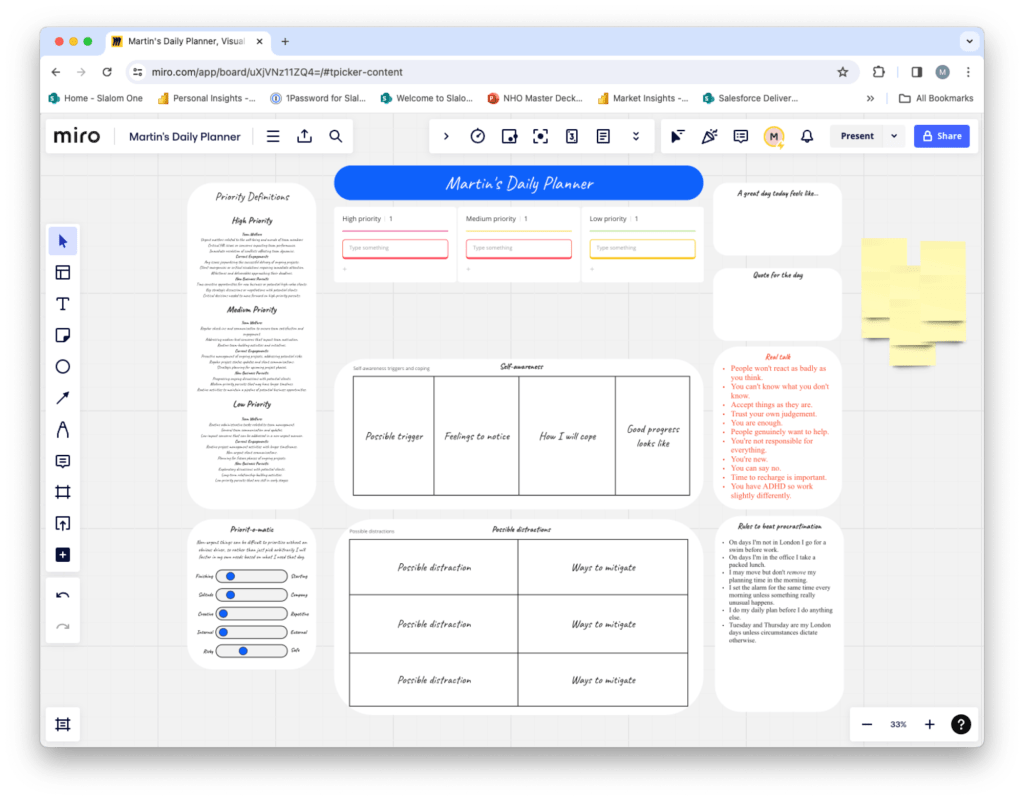
Most importantly, it is a system that acknowledges how my brain works rather than asking me to pretend it works differently.
Value
The main change here is self-honesty. Not denying what is difficult, and not relying on fear as the only source of focus.
I try to protect the planning time at the start of each work day. When it gets squashed, I notice the difference immediately. That has been the clearest evidence that the investment is worth it.

 Autist's Impression
Leave a comment